
Mobile Home Foundation Certifications
Frequently Asked Questions (FAQs)
Below are some answers to frequently asked questions for our FHA, HUD, and VA manufactured home foundation engineering certifications and inspections. If you can not find you answer here, please also go to our Glossary of Terms and Definitions page.
FAQs
- Do you perform FHA/HUD and VA foundation certifications on manufactured homes?
- Can you draw foundation plans for FHA/HUD and VA for manufactured homes?
- What are some of the requirements for a FHA/HUD manufactured home foundation certification?
- If the home was constructed according to Federal Manufactured Home Construction and Safety Standards (CFR 3280) was it installed on a permanent foundation?
- What is involved in a Manufactured Home Engineer Foundation Certification?
- What states do you cover?
- Modular vs Manufactured Homes; what is the difference between a modular home and a manufactured home, or mobile home?
- Can you determine if the foundation is HUD compliant without visiting the home site?
- How long does it take to issue an engineer foundation certification?
- How much does a manufactured home engineer foundation certification cost?
- Can the manufactured home be moved or relocated from a previous home site?
- What happens if you perform an on-site inspection and the foundation is not HUD compliant?
- What are the most common non-compliance issues that may cause a delay in the engineers foundation certification?
- If the foundation needs upgrades or a retrofit, who performs the work?
- After the retrofit and/or upgrades are performed on the manufactured home foundation, what is the next step?
- Can the upgrades that are performed by a contractor be paid at the same time of the closing of the loan?
- Once the engineering certificate is complete, how does the lender receive it?
- We are a mortgage company and need foundation certifications completed quite often; how do I become an on-going customer?
- How do I place an order for a manufactured home Engineering Foundation Certification?
- Do you perform FHA/HUD and VA foundation certifications on manufactured homes?
Yes, we certify foundations for manufactured homes for FHA/HUD, and VA loans, including other requirements of lenders and mortgage companies.
- Can you draw foundation plans for FHA/HUD and VA for manufactured homes?
Yes, we can design and draw engineereed foundation plans for manufactured homes for FHA/HUD, and VA loans, including make them compliant for local building codes. See our website at www.MobileHomeFoundation.com website for more info.
- What are some of the requirements for a FHA/HUD manufactured home foundation certification?
For all FHA/HUD certifications, the HUD Permanent Foundations Guide for Manufactured Homes (PFGMH), dated 1996 must be followed. This is a 405 page design standards manual issued by HUD for the manufactured housing industry as it pertains to permanent foundations.
- If the home was constructed according to Federal Manufactured Home Construction and Safety Standards (CFR 3280) was it installed on a permanent foundation?
Although your home was constructed to the Federal Manufactured Home Construction and Safety Standards (CFR 3280), that does not necessarily mean that it was installed on a permanent foundation. The Federal Manufactured Home Construction and Safety Standards pertain to the home itself (the walls, windows, heating and air conditioning, electrical, roof, etc.) and how it was constructed at the factory, but it does not pertain to the foundation; the foundation and the home superstructure are two separate animals. Manufactured homes can be placed on non-permanent foundations, or either permanent ones. What determines if it is permanent or not is the HUD's Permanent Foundation Guide for Manufactured Homes, dated 1996 (HUD Publication 7584, PFGMH).
All Manufactured Homes receive an overall HUD certificate of approval direct from the factory; they install a little red metal tag on the outside of the home to state this fact. However, since not all manufactured homes involve an FHA or VA loan to be sold, many are not installed on a permanent foundation (according to the PFGMH), and therefore, not all manufactured homes need a foundation certification. Many manufactured home dealerships do their own financing so they don't necessarily involve installing the home on a permanent foundation. Some dealerships install permanent foundations for all their homes they sell and some do not.
- What is involved in a Manufactured Home Engineer Foundation Certification?
An Engineer Foundation Certification involves several actions on our part. At a minimum:
- We perform an on-site inspection of the foundation where the home is located. We observe features and components of the foundation as it pertains to the permanent foundation standards of HUD.
- We review and verify compliance as it pertains to the HUD guidelines.
- If the foundation is in compliance to HUD standards, we issue the certification compliance letter. If the foundation is non-compliant to HUD standards, we issue a non-compliant letter with recommendations on how to bring the foundation into HUD compliance. ^ top
- What states do you cover?
We have a nationwide coverage, however, some states and/or services are excluded.
- Modular vs Manufactured Homes; what is the difference between a modular home and a manufactured home, or mobile home?
It can be confusing to tell the difference between a manufactured home, mobile home, and/or modular home. They can be very similar in appearance, and on top of that, many people use the terms interchangeably. So let's try to clear it all up and get a better definition.
What are Manufactured Homes?
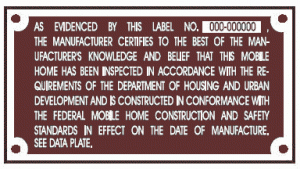 A manufactured home is any factory-built home in the United States that is built conforming to HUD Title 6 construction standards (commonly known as "the HUD-code"). The HUD-code was implemented and took effect starting June 15, 1976. A HUD-coded home will display documentation called the HUD Certification Label and the Data Plate. The red HUD Certification Label (sometimes called the "HUD Label") can be located on the tail end of each transportable section of the home (as shown here to the right). The Data Plate will be located inside of the home. A manufactured home is also built on a permanent chassis to ensure transportability. However, typically a manufactured home is not moved from its initial installed site. The home can then be placed on HUD permanent foundation. This is what we (Foundation Certifications) inspects and certifies when we visit your home-site.
What are Mobile Homes?
A mobile home is similar to a manufactured home, in that it is a factory-built home. However, it differs in that it is: 1) built before June 15, 1976, and 2) not built to any uniform construction code, including HUD, since the HUD code didn't come out until June 15, 1976. However, many people use the term "mobile home" to describe any factory-built home, and even use it interchangeably to describe a "manufactured home", which makes the the term very ambiguous. Generally speaking, when someone uses the term "mobile home", they are referring to a manufactured home.What are Modular Homes?
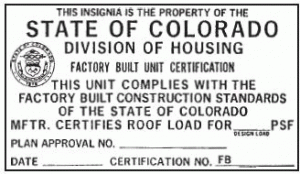 A modular home is any factory-built home that is constructed to a local (City or County), or state building code. In most cases, a state will have adopted one of the uniform construction codes (i.e. UBC, IRC, etc.). Modular homes will not have the red HUD Certification Label, but will have a different label (ofted called a "UBC Label", or similar) attached to the home stating the code it complies with (as shown here to the right). A modular home can be built as an "on-frame" or "off-frame" modular. On-frame will be built on a permanent chassis, whereas, the off-frame modular will be built with removal of the chassis frame in mind. An off-frame modular will usually require additional cranes to assist with home placement. Modular homes are, usually, only attached to private land, and not typically installed in manufactured (mobile) home parks.
 - Can you determine if the foundation is HUD compliant without visiting the home site?
Without a proper assessment, we generally can not tell you if the foundation is HUD compliant. All certifications require an inspection to determine compliance. Many times, an initial inspection may be required to determine if the foundation is HUD compliant, or if retrofits need to be done. Each foundation is unique due to geography, and sometimes local codes if they are more demanding than the national standards.
- How long does it take to issue an engineer foundation certification?
Most engineer foundation certifications can be issued within 3 to 5 days - sometimes even faster. We do have a 24 to 48 RUSH service also available.
- How much does a manufactured home engineer foundation certification cost?
Standard fees vary based on geographical location; in many areas across the country our standard fee can be as low as $425 for an on-site inspection and the engineer's certification (compliance letter). Please contact us for a price quote for your local area.
- What about FHA Insurance Eligibility - who is eligible?
To be eligible for FHA insurance, your manufactured (mobile) home must be on an FHA-approved permanent foundation. We, the registered professional engineers must certify that the foundation complies with the Permanent Foundations Guide for Manufactured Housing.
- Can the manufactured home be moved or relocated from a previous home site?
The manufactured unit must not have been installed or occupied previously at any other site or location. Manufactured units may be moved only from the manufacturer's or dealer's lot to the site on which the unit will be insured. If a permanent foundation is to be constructed under an existing eligible unit, the unit may be jacked up in order to install a new foundation.
- What happens if you perform an on-site inspection and the foundation is not HUD compliant?
If one of our inspectors performs an inspection and the foundation is non-compliant to HUD standards, we will follow this general procedure:
- Issue a non-compliance letter listing issues that need to be resolved and recommend if a small retrofit or completely new design needs to be completed.
- If required, after a local contractor installs components to bring the foundation into compliance
- We will need to perform a post-retrofit review of the installed components. Many times this will incude an on-site re-inspection by one of our local inspectors.
- If all the components have been installed according to our recommendations, we will then issue a letter from the engineer certifying that the foundation is in compliance and meets HUD standards.
- What are the most common non-compliance issues that may cause a delay in the engineers foundation certification?
One of the most common errors that we find causing a delay in the engineer's foundation certification is:
- The lack of anchors or tie-downs.
- Dilapidated skirting
- If the foundation needs upgrades or a retrofit, who performs the work?
Depending on what is required, a local contractor (licensed in your state) should install the components for an upgrade. We keep a list of local contractors that may be able to help you.
- After the retrofit and/or upgrades are performed on the manufactured home foundation, what is the next step?
After the retrofit and upgrades are performed, we will need to perform a post-retrofit review on the installed components. Many times we will have one of our local inspectors perform an onsite re-inspection. The complete fee for the foundation certification is not charged, however a small fee is charged to cover this additional extra work.
- Can the upgrades that are performed by a contractor be paid at the same time of the closing of the loan?
Many contractors will allow you to pay for the upgrades at closing. You will have to ask your local contractor about this option.
- Once the engineering certificate is complete, how does the lender receive it?
Engineering foundation certifications are generally emailed directly to you in PDF format. This is our standard form of delivery unless a hard copy is requested. If a hard copy is requested, several more days for delivery are required via United States Postal Service.
- What are your payment options?
We have 4 different payment options, these are:
- Engineer will invoice Lender. Title Company will pay engineer at closing by check. (If loan fails to fund, home owner guarantees payment by credit card.)
- Home Owner can pre-pay by Credit/Debit Card.
- Home Owner can pre-pay by Cashier's Check.
- Home Owner can pre-pay by sending us a Personal Check.
- We are a mortgage company and need foundation certifications completed quite often; how do I become an on-going customer?
To become an on-going customer is very simple. Simple contact us via our online form, or call us at
 and we can get you setup in our database so that you can place orders on an on-going basis.
 - How do I place an order for a manufactured home Engineering Foundation Certification?
Orders are placed on our secure website. Our online order process was created to save you time. There are no paper forms to fill out, and no faxes to send. If you have an Internet connection, you can place an order - it's that simple.
- Can you determine if my foundation is HUD compliant without visiting my home site?
- What is a HUD/FHA compliant manufactured home foundation?
- Can you draw plans for mobile home foundations?
- Can my manufactured home be moved or relocated from a previous home site?
- What all is involved in an Manufactured Home Engineer Foundation Certification?
- Who is required to have a HUD manufactured home foundation certification?
- What about FHA Insurance Eligibility?
- What is most often required when buying a manufactured home with an FHA-insured loan?
- How can I gain compliance with the HUD/FHA requirements for my manufactured home permanent foundation?
- My manufactured home was constructed according to Federal Manufactured Home Construction and Safety Standards (CFR 3280); does that mean it was installed on a permanent foundation?
- Why is a professional licensed engineer required for a foundation certification?
- If my foundation was installed according to my local building department's codes doesn't that mean that it meets HUD standards as a permanent foundation?
- What will happen if my manufactured home does not have a HUD compliant foundation?
- Who really cares if my foundation is HUD/FHA compliant?
- My manufactured home qualified for an FHA loan in the past, will it qualify now?
- If my foundation is HUD compliant, will it meet other loan standards?
- Does a HUD compliant foundation cost more than other types of foundations?
- Is a contractor required to install a HUD compliant foundation or its components?
- If I know a contractor to do retrofits or to build a new foundation; what is my next step?
- How do I place an order for a manufactured home foundation certification?
- What are your Payment Options?
- Can you determine if my foundation is HUD compliant without visiting my home site?
Without a proper assessment, we generally can not tell you if your foundation is HUD compliant. All certifications require an inspection to determine compliance. An initial onsite inspection is required to determine if the foundation is HUD compliant, or if retrofits need to be done. Each foundation is unique due to geography, and local codes.
We are bound by a 405 page engineering manual, however at a minimum, several compliance issues that must be met; these are:
- A permanent skirting around the perimeter to protect the foundation from vermin and water intrusion.
- Proper piers to support the structure, including frost protection of those piers.
- Anchorage to resist loads caused by wind and earthquake forces.
&nbnbsp;
- What is a HUD/FHA compliant manufactured home foundation?
A HUD compliant foundation is a foundation that has been certified by a professional licensed engineer that it complies to the HUD Permanent Foundations Guide for Manufactured Homes (PFGMH), dated 1996. This is what we do for our customers.
- Can you draw plans for mobile home foundations?
Yes, we can design and engineer and draw foundation plans for manufactured homes for all loan types, including make them compliant for local building codes. See our other website at www.MobileHomeFoundation.com for more info.
- Can my manufactured home be moved or relocated from a previous home site?
Your manufactured unit must not have been installed or occupied previously at any other site or location. Manufactured units may be moved only from the manufacturer's or dealer's lot to the site on which the unit will be insured. If a permanent foundation is to be constructed under an existing eligible unit, the unit may be jacked up in order to install a new foundation.
- What all is involved in an Manufactured Home Engineer Foundation Certification?
An Engineer Foundation Certification involves several actions on our part. At a minimum:
- We perform an on-site inspection of the foundation where the home is located. We observe features and components of the foundation as it pertains to the permanent foundation standards of HUD.
- We review the inspection report and verify compliance as it pertains to the HUD guidelines.
- If the foundation is in compliance to HUD standards, we issue the certification compliance letter. If the foundation is non-compliant to HUD standards, we issue a non-compliant letter with recommendations on how to bring the foundation into HUD compliance.
- Who is required to have a HUD manufactured home foundation certification?
Anyone applying for an FHA secured loans. According to HUD-FHA Single Family Housing, Homeownership Center Reference Guide
Revised October 31, 2005, "All foundation systems, new and existing, must meet the guidelines published in the Permanent Foundations Guide for Manufactured Housing, (HUD-7584), dated September 1996. A certification attesting to compliance with this handbook must be obtained from a licensed professional engineer and included in the insuring file." - What about FHA Insurance Eligibility?
To be eligible for FHA insurance, your manufactured (mobile) home must be on an FHA-approved permanent foundation. A registered professional engineer must inspect and certify that the foundation complies with the Permanent Foundations Guide for Manufactured Housing.
- What is most often required when buying a manufactured home with an FHA-insured loan?
There are two types of FHA-insured loans available to purchase a manufactured home.
A Title I loan for a manufactured home requires one of the following:
- A certification label attached to the home, or
- A label verification letter. Obtain a label verification letter by visiting the website of the HUD-approved contractor, the Institute for Building Technology and Safety (IBTS), or at (703) 481-2010.
Title II insures mortgages on qualifying manufactured homes sold with land and meeting other requirements including all of the following:
- A certification label or label verification letter.
- The placement of the home on a permanent foundation that complies with the Permanent Foundations Guide for Manufactured Housing (PFGMH).
- A certification from a licensed professional engineer (like our engineers at Foundation Certifications) verifying compliance with the PFGMH.
Note: You may wish to consult with private lending institutions to see if additional financial options are available to you.
- How can I gain compliance with the HUD/FHA requirements for my manufactured home permanent foundation?
According to federal regulations, in order to meet the requirements for a manufactured home permanent foundation you must comply with the Permanent Foundations Guide for Manufactured Housing, (HUD-7584), dated September 1996. Generally speaking, this means we must inspect your foundation to see if it complies with this code. If it does comply, then we will issue an engineer certification. If it does not comply, then we will recommend a retrofit and/or upgrade to bring it into compliance.
All certifications require an inspection to determine compliance. Many times, an initial inspection may be required to determine if the foundation is HUD compliant, or if retrofits need to be done. Each foundation is unique due to geography, and local codes.
At a minimum, there are several compliance issues that must be met; these are:
- A permanent skirting around the perimeter to protect the foundation from vermin and weather.
- Proper piers to support the structure, including frost protection of those piers.
- Anchorage to aid in resisting lateral loads caused by wind and earthquake forces.
- My manufactured home was constructed according to Federal Manufactured Home Construction and Safety Standards (CFR 3280); does that mean it was installed on a permanent foundation?
Although your home was constructed to the Federal Manufactured Home Construction and Safety Standards (CFR 3280), that does not necessarily mean that it was installed on a permanent foundation. The Federal Manufactured Home Construction and Safety Standards pertain to the home itself (the walls, windows, heating and air conditioning, electrical, roof, etc.) and how it was constructed at the factory, but it does not pertain to the foundation; the foundation and the home superstructure are two separate animals. Manufactured homes can be placed on non-permanent foundations, or either permanent ones. What determines if it is permanent or not is the HUD's Permanent Foundation Guide for Manufactured Homes, dated 1996 (HUD Publication 7584, PFGMH).
All Manufactured Homes receive an overall HUD certificate of approval direct from the factory; they install a little red metal tag on the outside of the home to state this fact. However, since not all manufactured homes involve an FHA or VA loan to be sold, many are not installed on a permanent foundation (according to the PFGMH), and therefore, not all manufactured homes need a foundation certification. Many manufactured home dealerships do their own financing so they don't necessarily involve installing the home on a permanent foundation. Some dealerships install permanent foundations for all their homes they sell and some do not.
- Why is a professional licensed engineer required for a foundation certification?
Foundation systems for any home is a complex engineering design process. In order to safeguard, life, health and property, to promote the public welfare, and to establish and maintain a high standard of integrity and practice, a professional licensed engineer is required.
- If my foundation was installed according to my local building department's codes doesn't that mean that it meets HUD standards as a permanent foundation?
The short answer is maybe. We have to follow the most stringent of the local code or the national HUD standard. Sometimes local codes are more stringent but not always. More times than not, the HUD national standard is the more stringent code to follow. So, your home may have been installed to local codes, but may not have been installed to the requirements outlined in the HUD Permanent Foundations Guide for Manufactured Homes, dated 1996. If this is the case, a retrofit may need to be performed to bring it up to the HUD national standards. During our engineering review we will determine if your foundation meets the definition of a permanent foundation.
- What will happen if my manufactured home does not have a HUD compliant foundation?
HUD compliant manufactured home foundations have some of the highest standards in the industry. If you do not have a HUD compliant foundation, you will most likely be denied a loan that is secured by the Federal government including HUD, FHA, VA and possibly others. If you live in a home that is non-compliant to HUD standards, and if you decide to sell, you may be required to fulfill this standard. Also, if you decide to refinance with a Federally guaranteed loan, you will most likely be denied.
You benefit by ensuring your home is installed on a HUD compliant permanent foundation from the beginning. We can design a HUD compliant foundation for you if you are having a new home installed. We can also recommend a retrofit to make your manufactured home HUD compliant if it was not originally installed on a permanent foundation. The process is fast and affordable. Just go here to place your order for a foundation certification.
- Who really cares if my foundation is HUD/FHA compliant?
Well, a lot of people care; and especially lending companies. The lending company wants to ensure that the foundation can properly support the home and that it will not falter. Different lending companies have different regulations. Older homes may have been put on grade with blocks or some other home-made device. However, current standards are more stringent and require a safer design. These designs are to safeguard the home in the event of an earthquake or extreme wind storm (such as a hurricane.) It is the government (HUD) that has set the national standards and codes for manufactured homes.
- My manufactured home qualified for an FHA loan in the past, will it qualify now?
The answer to this is "maybe". It depends on what type of foundation you have. National standards evolve over time and change frequently. If you are in compliance or not, can only be determined by an on-site inspection and a review by our professional engineering staff. One thing to remember is that manufactured home foundations are not adopted automatically into the current standards - each foundation must meet the current standards in order to qualify for most loans.
- If my foundation is HUD compliant, will it meet other loan standards?
The short answer is, most likely. We have never seen a current HUD compliant foundation not meet all other existing loan requirements from other agencies. If it is HUD compliant, it has one of the highest ranking foundation standards in the industry.
- Does a HUD compliant foundation cost more than other types of foundations?
First of all, a HUD compliant foundation is not a type of a foundation, but a standard by which the foundation is built. HUD has some of the highest standards concerning permanent foundations for manufactured homes.
Some standards that are allowed by other regulatory agencies (including your local government agencies) might not require the same level of detail and design considerations as a HUD compliant foundation. Some local agencies may. With that said, due to the higher standards, it may cost more money up-front to build a HUD compliant foundation than to build to the minimum standard the industry allows.
However, it costs less to put in a HUD compliant foundation at the beginning, than to find out you need one later, and need to retrofit it. Then you're paying twice. Also, you may find yourself wanting to eventually sell the home but can't find a buyer because the bank won't loan money on it due to it not being HUD compliant. Something to think about.
- Is a contractor required to install a HUD compliant foundation or its components?
You will want to check with local regulatory agencies, but generally, any licensed contractor that knows something about foundations, concrete work, and/or manufactured homes can most likely perform the work. Depending on your local and state regulations, a certified mobile home installer will be required to perform any retrofit or installation work.
It is very important to involve us from the beginning in order to ensure that all standards are met.
- If I know a contractor to do retrofits or to build a new foundation; what is my next step?
The first step is to have them contact us. We work with a multitude of contractors and certified installers and we will recommend a retrofit (or design) the right HUD compliant foundation for your home at the most economical price.
- How do I place an order for a manufactured home foundation certification?
If you are a home owner, you may place your order here.
- What are your Payment Options?
We have 4 different payment options, these are:
- Engineer will invoice Lender. Title Company will pay engineer at closing by check. (If loan fails to fund, home owner guarantees payment by credit card.)
- Home Owner can pre-pay by Credit/Debit Card.
- Home Owner can pre-pay by Cashier's Check.
- Home Owner can pre-pay by sending us a Personal Check.
- In California, what are the different classifications of foundations?
- What is California Form 433a?
- What is the purpose of the California 433 forms?
- What does a recorded 433a document in California accomplish?
- Where do I get a 433A form?
- Who completes California Form 433a?
- When is California Form 433a to be submitted for processing?
- How do I record the Form HCD 433A with the Department of Housing and Community Development (HCD)?
- What happens after California Form 433a is recorded?
- How do I report to HCD the completed installation of a retrofitted Permanent Foundation System?
- What is a California Certificate of Occupancy (HCD Form 513c)?
- What is a California Statement of Mobilehome Installation Acceptance?
- Who issues the California Installation Acceptance or Certificate of Occupancy?
- When is the California Installation Acceptance or Certificate of Occupancy issued?
- What is California HCD Form 413?
- What is California HCD Form 433c?
- In California, what are the different classifications of foundations?
In California, the installation of a manufactured (mobile) home on a foundation is classified as one of the following:
(A) Foundation installation - a fixture or improvement to real property, recorded with the county recorder's
office, once recorded it is no longer personal property, and which complies with the requirements of Health and
Safety Code section 18551(a); or(B) Chattel installation - neither a fixture nor an improvement to real property, not recorded with the county recorder's office, remains personal property, and which complies with the requirements of Health and Safety
Code section 18551(b). - What is California Form 433a?
In California, to convert the manufactured home to real property, Form 433a must be recorded. Generally speaking, the recorded 433A is required by the mortgage lender and/or the Title Company. Form 433A is a California Department of Housing and Community Development (HCD) Form. It is also known as "Installation of a Manufactured Home on a Foundation System".
The 433a form can be downloaded from the CA HCD website.
The California Department of Housing and Community Development requires manufactured housing owners who affix their units to foundation systems to record a form known as Form 433A with HCD. The form is to be completed at the time a building permit is issued. After installation has been approved and on the sameday the certificate of occupancy has been issued, HCD shall record Form 433A with the county recorder's office. Thus, a preliminary title report should reveal whether a Form 433A was recorded.
- What is the purpose of the California 433 forms?
- The 433A provides this department (HCD) notification from the local agency issuing the installation permit that a manufactured home or commercial modular structure has been installed on a foundation system on private property and has been approved for occupancy. HCD uses this information for the date it will no longer register the unit(s).
- The 433C provides this department notification from the local agency issuing the installation permit that a manufactured home in a resident-owned mobilehome park has been installed on a foundation system and has been approved for occupancy. HCD uses this information as the date it will no longer register the unit(s).
- The 433B accompanies the 433A and 433C as a notice to the County Assessor's office of the change to the property status and to calculate the new property tax assessment. The 433B is not used by HCD.
- What does a recorded 433a document in California accomplish?
When completed by the governing building division and recorded by the City/County Recorder, the form certifies that the manufactured home was installed on a California-approved permanent foundation or foundation system and acts as an investment instrument (security) to the mortgage lender, the Title Company and even the homeowner. Once recorded it ensures that the home is no longer personal property, but real property subject to real property taxes - and this is what's required for most FHA, VA, and conventional loans.
- Where do I get a 433A form?
Since it is the responsibility of the local agency issuing the installation permit to complete and submit 433 forms, these forms generally are made available to the local city, and county building departments.
- Who completes California Form 433a?
Generally speaking, the owner (or their representatives) completes the Owner Information Section and the Unit Description section, and the Building Division generally completes the remaining sections. The manufacturer's name, date of manufacture, model name/number, and serial number can be found on the Manufacturer Data Plate usually located on the base cabinet under the kitchen sink. The insignia (State of California) numbers can be located on each unit section, usually at the back end of each unit section (Two insignia numbers are required for a double-wide and three insignia numbers for a triple-wide).
- When is California Form 433a to be submitted for processing?
Generally, the form can be submitted for processing after all the required building foundation and home attachment inspections have been completed and approved by the governing building division.
- How do I record the Form HCD 433A with the Department of Housing and Community Development (HCD)?
The 433A is not "recorded" with HCD. It is only recorded with the County Recorder's Office in the county where the home is located. State law requires that on the same day that the Certificate of Occupancy is issued, the enforcement agency must record the 433A with the county recorder of the county where the real property is situated.
- What happens after California Form 433a is recorded?
A recorded copy is sent to the California Housing and Community Development and to the property owner in conjunction with a final Certificate of Occupancy.
- How do I report to HCD the completed installation of a retrofitted Permanent Foundation System?
- For existing manufactured homes (installed with a new/retrofitted foundation system):
The buyer must submit four sets of documents: (1) the properly endorsed title document or a Statement of Facts that the title document was surrendered to the local building department or HCD at the time the permit to install was obtained; (2) the license plates or decals or a Statement of Facts that these items have been destroyed; (3) a copy of the recorded 433A; and (4) any back renewal fees that may be due. Please note that a Statement of Facts in lieu of the recorded 433A is not allowed. - For all manufactured homes:
Once the recorded copy of the 433A and other required documents are received by HCD, the "pending installation" or "owner-builder" status will be changed to "permanent foundation."
- For existing manufactured homes (installed with a new/retrofitted foundation system):
- What is a California Certificate of Occupancy (HCD Form 513c)?
The certificate of occupancy shall be provided for a manufactured (mobile) home installed on foundation system pursuant to section 18551(a) of the Health and Safety Code. California State Health and Safety Code §18551 requires that a Certificate of Occupancy be issued for the occupancy of a manufactured home as a fixture on real property. Form 513c is used for recording. Once recorded, the dwelling becomes taxable as real property by the County and is removed from the State personal property tax roll. To complete this process, the State documents must be completed including form 433a. After form 513c is issued (in the field), the building department is required to record HCD Form 433a immediately thereafter.
- What is a California Statement of Mobilehome Installation Acceptance?
The manufactured (mobile) home unit installation acceptance shall be provided for mobile homes installed pursuant to section 18551(b) or 18613 of the Health and Safety Code.
- Who issues the California Installation Acceptance or Certificate of Occupancy?
The enforcement agency (county, city, building official, etc.) provides copies of the statement of manufactured home installation acceptance or certificate of occupancy for the manufactured home to the installer or other person holding the permit to install and the buyer or registered owner or their representative.
- When is the California Installation Acceptance or Certificate of Occupancy issued?
A "Mobilehome Installation Acceptance" or "Certificate of Occupancy" shall not be issued until it is determined that the manufactured (mobile) home unit installation complies with the provisions of chapter 1366 of Title 25 of the California Mobilehome Parks and Installations Regulations.
- What is California HCD Form 413?
The California HCD Form 413 was replaced by HCD Form 433a in 1986.
- What is California HCD Form 433c?
The California HCD Form 433c can only be recorded by an escrow agent. It gives public notice that the "Registered Owner" elects to convert their home from personal property to a fixture on the land (real property).
Also, it is the only exception in California when a manufactured home can be converted to a fixture without being on a "Foundation System" as outlined in California Code 18551. The requirements for this are:
- The manufactured (mobile) home must be on land in a manufactured home park.
- The manufactured (mobile) home land (park) was (or will) be converted to a resident-owned subdivision, cooperative, condominium, or nonprofit corporation pursant to California Code 11010.8.
- The "Registered Owner" is a participant in the resident ownership of the park.


